The traditional process of making Azulejo tiles remains remarkably unchanged since the 16th century. At our Goa workshop, each tile passes through four distinct stages over several weeks. There is no automation at any point — every single step is performed by hand, and every tile carries the subtle marks and character of its maker.
This page documents exactly how we make our tiles, in the same level of detail we'd share with a fellow ceramicist. We believe transparency about our process is what separates genuine handcraft from mass-produced imitations.
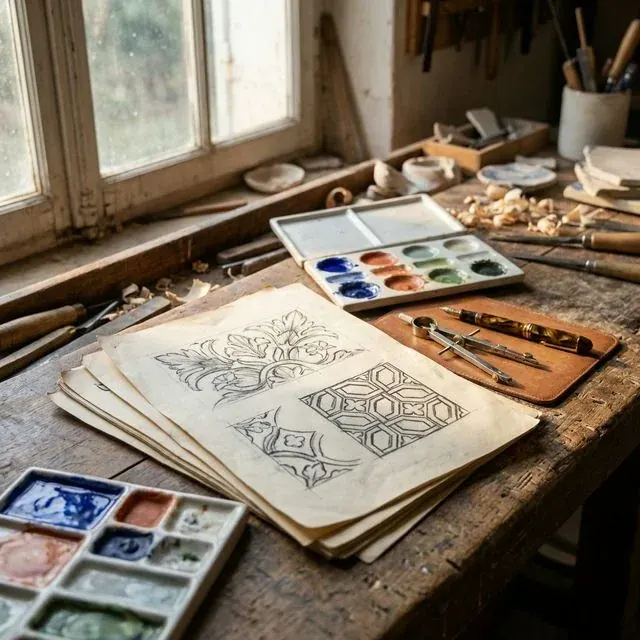
Your Brief & Design Drawing
Every commission starts with a conversation. You share your family name, house number, preferred motif, colour preferences, and any personal touches. Our artist then hand-draws the design on paper using traditional compass and straight-edge — no computer software is involved.
You receive a design preview before any clay is touched. Three revisions are included free. This collaborative process ensures the final tile reflects exactly what you envision.
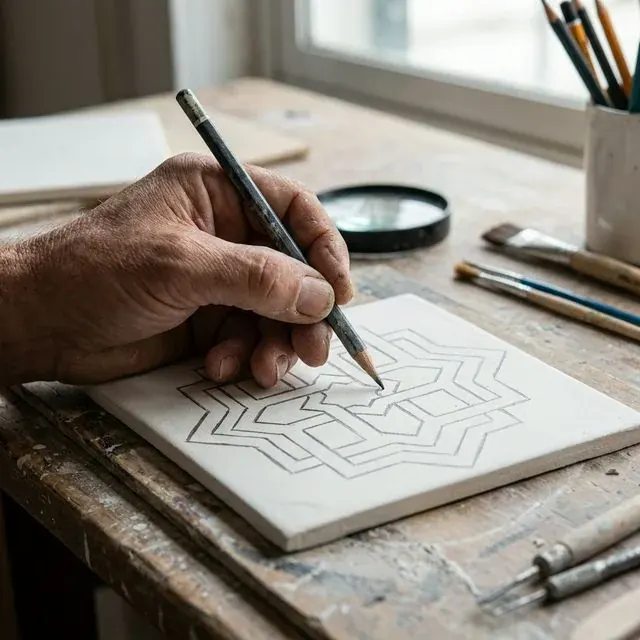
Clay Preparation & Bisque Firing
We use high-quality earthenware clay, shaped into flat tiles of the required dimensions. The raw tiles are dried slowly over several days to prevent cracking — rushing this stage would compromise the entire piece.
The dried tiles then enter the kiln for their first firing, called bisque firing, at approximately 900°C. This transforms the raw clay into a hard, porous ceramic body (called "bisqueware") that is ready to accept paint and glaze. The bisque surface has a characteristic terracotta colour and a slightly rough, absorbent texture — essential for the pigments to grip properly.
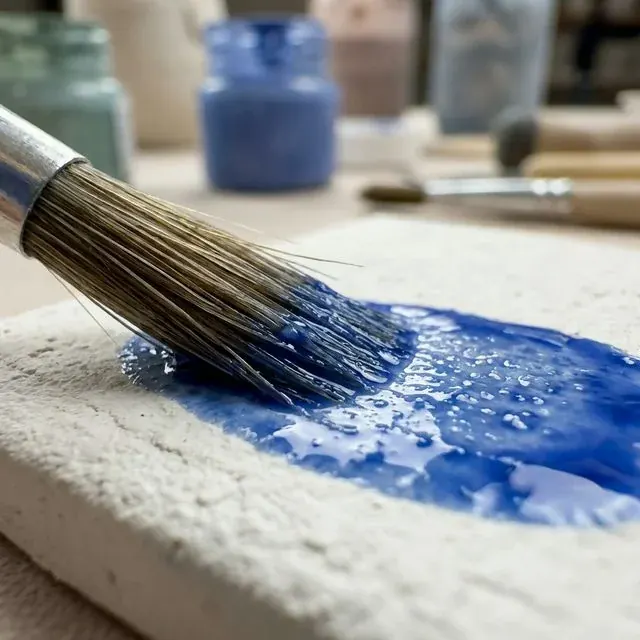
Hand-Painting with Cobalt Oxide
This is the heart of the process and where the skill of the artist is most apparent. Using fine brushes, the artist hand-paints the approved design directly onto the bisque tile.
The primary pigment is cobalt oxide — the same material that has given Azulejo tiles their iconic blue colour for 500 years. We also use manganese (for brown and purple tones), copper oxide (for green), and iron oxide (for warm reds and yellows).
At this stage, the pigments look grey and dull. The brilliant colours only reveal themselves after the final firing. A single nameplate takes between 8 and 40 hours of careful brushwork, depending on complexity.
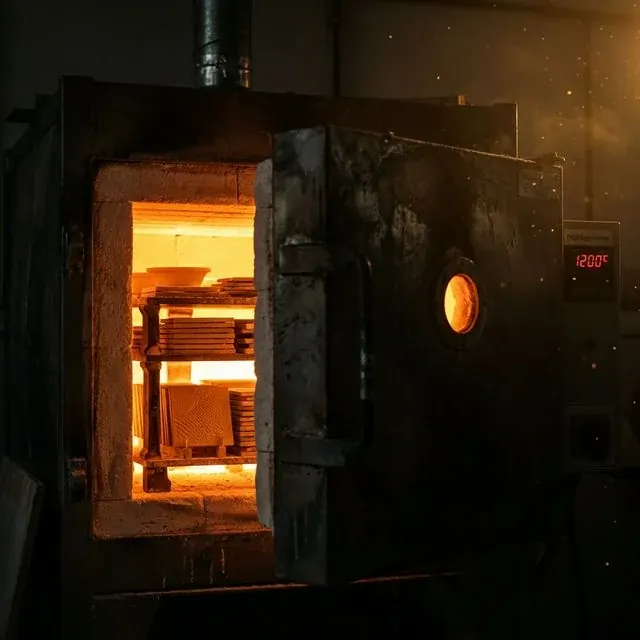
Glaze & Final Kiln Firing at 1200°C
A tin-based opaque white glaze is applied over the painted surface. This glaze gives Azulejos their characteristic glossy, luminous finish and protects the design underneath.
The glazed tile goes back into the kiln at approximately 1200°C. At this temperature, something remarkable happens: the glaze melts and fuses permanently with the clay body, and the cobalt oxide transforms into its brilliant, permanent blue. The pigments don't sit on the surface — they become part of the ceramic itself.
The result is a tile that is completely waterproof, fade-proof, and frost-resistant — engineered to survive Indian monsoons, coastal salt air, and tropical heat for centuries.
"Azulejos are not paint on ceramic. They are ceramic that has become paint. The glaze becomes one with the clay — permanent, waterproof, and eternal."
Why Handpainted Is Different
Many sellers market "ceramic nameplates" that are actually digitally printed using inkjet technology — the same process used for mass-produced commercial floor tiles. While cheaper, these printed tiles are fundamentally different from hand-painted Azulejos:
- Printed tiles use surface-level ink that sits on top of the glaze. Over time, especially outdoors, this ink can wear, chip, and fade.
- Hand-painted tiles use oxide pigments that are chemically fused into the ceramic body at 1200°C. They literally cannot fade — the colour is part of the material.
- Printed tiles are mass-produced and every copy is identical. Hand-painted tiles carry subtle brush strokes, slight imperfections, and depth of colour that make each piece genuinely one of a kind.
- Printed tiles are typically single-fired at lower temperatures. Our tiles are double-fired — first the bisque at 900°C, then the glaze at 1200°C — making them significantly more durable.
Every AzulejosGoa tile is made using this exact 500-year-old process. No digital printing. No shortcuts. 100% hand-painted, always.
See Our Nameplates