The Origin of Azulejos
The word "Azulejo" comes from the Arabic "al-zulaij" (الزليج), meaning "polished stone." Azulejos are hand-painted, tin-glazed ceramic tiles that have been a defining feature of Portuguese architecture for over 500 years. They are not merely decorative — in Portugal and Goa, they tell stories, commemorate events, and transform entire building facades into living works of art.
The tradition began in the 15th century when King Manuel I of Portugal visited the Alhambra in Spain and was captivated by the Moorish tilework. He brought the technique back to Lisbon, where Portuguese artisans transformed it into their own distinctive style — characterized by the iconic cobalt blue and white palette that the world now recognizes.
How Azulejos Came to Goa
When Portuguese explorers colonized Goa in 1510, they brought their ceramic tile tradition with them. Over the centuries, Goan artisans adapted the techniques, blending Portuguese motifs with local Indian imagery — resulting in a uniquely Indo-Portuguese style that exists nowhere else in the world.
You can still see historic Azulejos adorning the churches of Old Goa, the mansions of Fontainhas (Panjim's Latin Quarter), and the heritage homes of Margao and Chandor. These tiles feature everything from religious iconography and floral patterns to depictions of daily Goan life — fisherwomen, boats, churches, and tropical flora.
"Azulejos are not paint on ceramic. They are ceramic that has become paint. The glaze becomes one with the clay — permanent, waterproof, and eternal."
How Azulejo Tiles Are Made
The traditional process of making Azulejo tiles remains remarkably unchanged since the 16th century. Here is how each tile is crafted at our Fontainhas studio:
1. Clay Preparation & Bisque Firing
Raw earthenware clay is shaped into flat tiles and dried slowly. The tiles are then fired in a kiln at approximately 900°C (bisque firing). This creates a porous, terracotta-coloured base ready to accept the glaze.
2. Hand-Painting with Cobalt Oxide
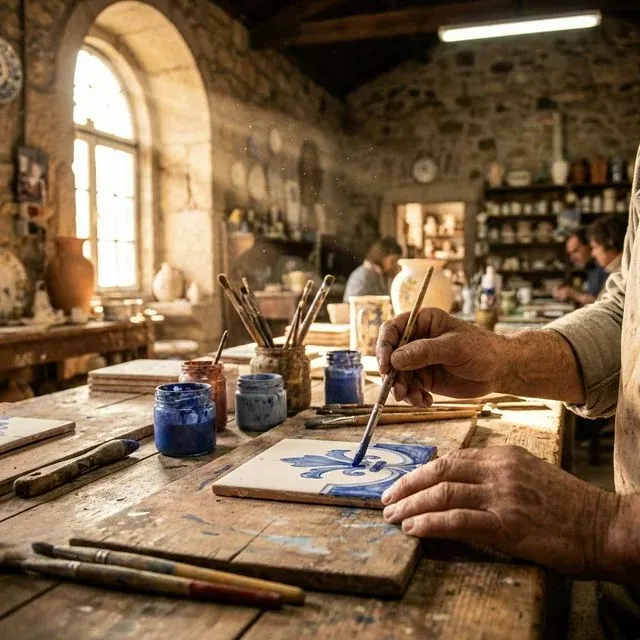
Using fine brushes, the artist hand-paints the design directly onto the bisque tile using cobalt oxide (for blue), manganese (for brown/purple), and copper oxide (for green). The pigments look grey and dull at this stage — the colour only reveals itself after the final firing.
3. Glaze Application
A tin-based opaque white glaze is applied over the painted surface. This glaze is what gives Azulejos their characteristic glossy, luminous finish and protects the painted design underneath.
4. Final Kiln Firing at 1200°C
The glazed tile goes back into the kiln at approximately 1200°C. At this temperature, the glaze fuses permanently with the clay body, and the cobalt oxide transforms into its brilliant, permanent blue. The result is a tile that is completely waterproof, fade-proof, and frost-resistant — built to last centuries.
Every AzulejosGoa tile is made using this exact 500-year-old process. No digital printing. No shortcuts. 100% hand-painted, always.
See Our ProcessAzulejos in Modern India
Today, Azulejo tiles are experiencing a remarkable renaissance across India. What was once a purely Goan art form is now sought after by homeowners in Bangalore, Mumbai, Delhi, Pune, and Chennai — drawn to the combination of heritage craftsmanship and timeless beauty.
The most popular use of Azulejos in modern India is the custom ceramic nameplate — a personalised tile featuring a family's name, house number, and chosen motif, hand-painted in the traditional Portuguese style. These nameplates are:
- Completely weatherproof — kiln-fired at 1200°C, they withstand monsoons, tropical heat, and UV exposure without fading
- One-of-a-kind — every single tile is individually hand-painted, so no two are ever identical
- A statement of taste — they instantly distinguish a home from the generic acrylic and stainless steel signs that dominate Indian streets
- A meaningful gift — perfect for housewarmings, weddings, anniversaries, and festivals
Azulejo vs. Printed Ceramic Tiles: What's the Difference?
Many online sellers market "ceramic nameplates" that are actually digitally printed using inkjet technology — the same process used for commercial floor tiles. While cheaper, these printed tiles are fundamentally different from authentic hand-painted Azulejos:
- Printed tiles are mass-produced and identical. Hand-painted tiles are unique works of art.
- Printed tiles use surface-level ink that can wear away. Hand-painted tiles use oxide pigments fused into the ceramic body at 1200°C — they literally cannot fade.
- Printed tiles lack the subtle brush strokes, slight imperfections, and depth of colour that make genuine Azulejos so beautiful.
"The difference between a printed tile and a hand-painted Azulejo is the difference between a poster and an oil painting. Both show an image, but only one has soul."
Where to Buy Authentic Azulejos in India
If you're looking for authentic, hand-painted Azulejo tiles in India, AzulejosGoa is one of the few studios that continues the traditional process. Based in Fontainhas (Panjim's Portuguese Latin Quarter), we craft every tile by hand and ship free across India — to Bangalore, Mumbai, Delhi, Chennai, Pune, Hyderabad, and beyond.
Our custom nameplates start from ₹2,800 and include free shipping, 3 design revisions, and a certificate of authenticity.
Ready to own a piece of 500 years of heritage? Order your custom hand-painted Azulejo nameplate today.
Order Your Custom Tile