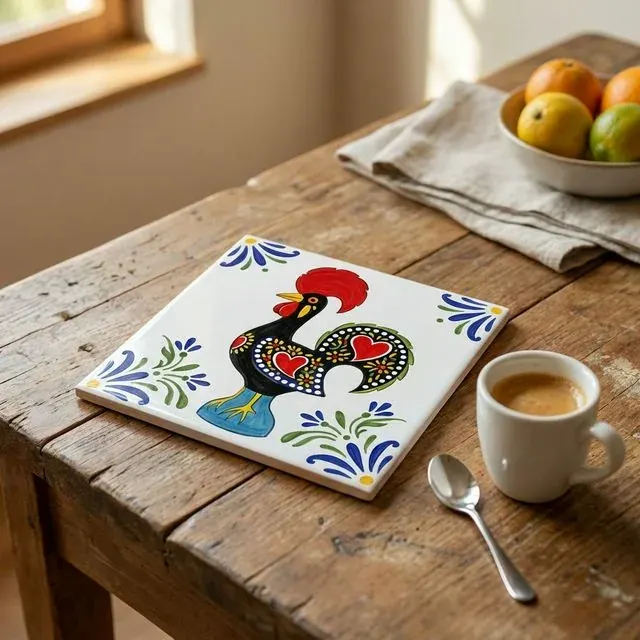
The Galo de Barcelos (Rooster of Barcelos) is a vibrantly painted rooster that symbolises faith, justice, and good fortune. Originating from a medieval Portuguese legend, it travelled to Goa with Portuguese colonists and became one of the most recognisable symbols of Goan-Portuguese cultural identity. Today, you'll find it painted on tiles, carved in wood, and displayed in homes across Goa.
The Legend of the Rooster of Barcelos
The story dates to the Middle Ages in Barcelos, a small town in northern Portugal. According to the legend:
A pilgrim passing through Barcelos on his way to Santiago de Compostela was falsely accused of stealing silver. Despite his protests of innocence, he was sentenced to death by hanging. As a final plea, he asked to be brought before the judge who had condemned him.
The judge was having dinner — a roasted rooster sat on his plate. The pilgrim pointed at the rooster and declared: "As surely as I am innocent, that rooster will stand up and crow."
The judge laughed and pushed his plate aside. But moments later, the roasted rooster stood up on the plate and crowed.
"As surely as I am innocent, that rooster will stand up and crow."
— The pilgrim's declaration, from the Legend of Barcelos
The judge, stunned, rushed to the gallows — just in time to find that the knot in the rope had prevented the hanging. The pilgrim was released and went free. Years later, he returned to Barcelos and erected a stone cross with the image of a rooster to commemorate the miracle.
How the Galo Came to Goa
Portuguese colonists brought the Galo de Barcelos symbol to Goa during the 451-year colonial period (1510–1961). It became embedded in Goan-Portuguese culture as a talisman representing divine justice and protection.
In Goa, the rooster took on additional cultural layers:
- Household guardian — displayed at entrances to bring good luck and ward off evil
- Cultural identity marker — for Goan Catholic families, the Galo represented their unique Portuguese-Indian heritage
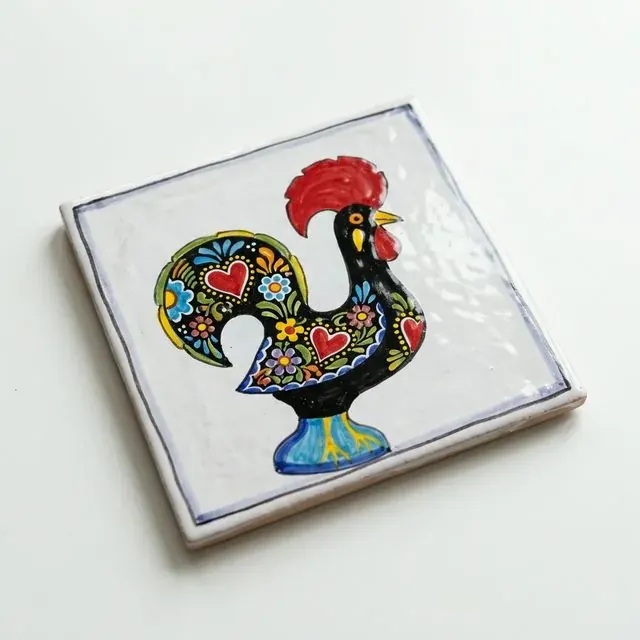
- Artisan tradition — Goan potters and tile painters incorporated the rooster into Azulejo tiles, creating a distinctly Indo-Portuguese version with tropical colours and Goan motifs
The Galo in Modern Goa
Walk through Fontainhas (Panaji's Latin Quarter), and you'll see the Galo de Barcelos everywhere — on tiles set into walls, painted on restaurant facades, carved into wooden furniture, and sold as souvenir figurines. It has transcended its colonial origins to become a symbol of Goa itself.
At AzulejosGoa, the rooster is one of our most requested designs. We hand-paint it on ceramic nameplates and decorative tiles using traditional cobalt oxide pigments, following the same Azulejo tile-making process that Portuguese masters used centuries ago.
Where to See Original Galos in Goa
- Fontainhas, Panaji — the Latin Quarter has numerous Galo tiles on heritage building facades
- Reis Magos Fort — restored Portuguese fort with ceramic tile displays
- Goa State Museum, Panaji — houses Indo-Portuguese ceramic collections
- Ancestral Goa Museum, Loutolim — recreated Goan village with traditional tile work
Why the Rooster Endures
The Galo de Barcelos endures because it tells a universal human story — an innocent person saved by faith, a miracle that defies power. It doesn't matter whether you're Portuguese, Goan, Christian, Hindu, or atheist. The story resonates because we all want to believe that justice prevails, that the truth comes out, that innocence is protected.
When a family hangs a hand-painted rooster nameplate at their door, they're not just displaying decoration. They're placing a 700-year-old symbol of protection and truth at the threshold of their home. That's why we take such care painting every feather, every comb, every spur — because the Galo isn't just a design. It's a story.